Brand Strategy
July 2026
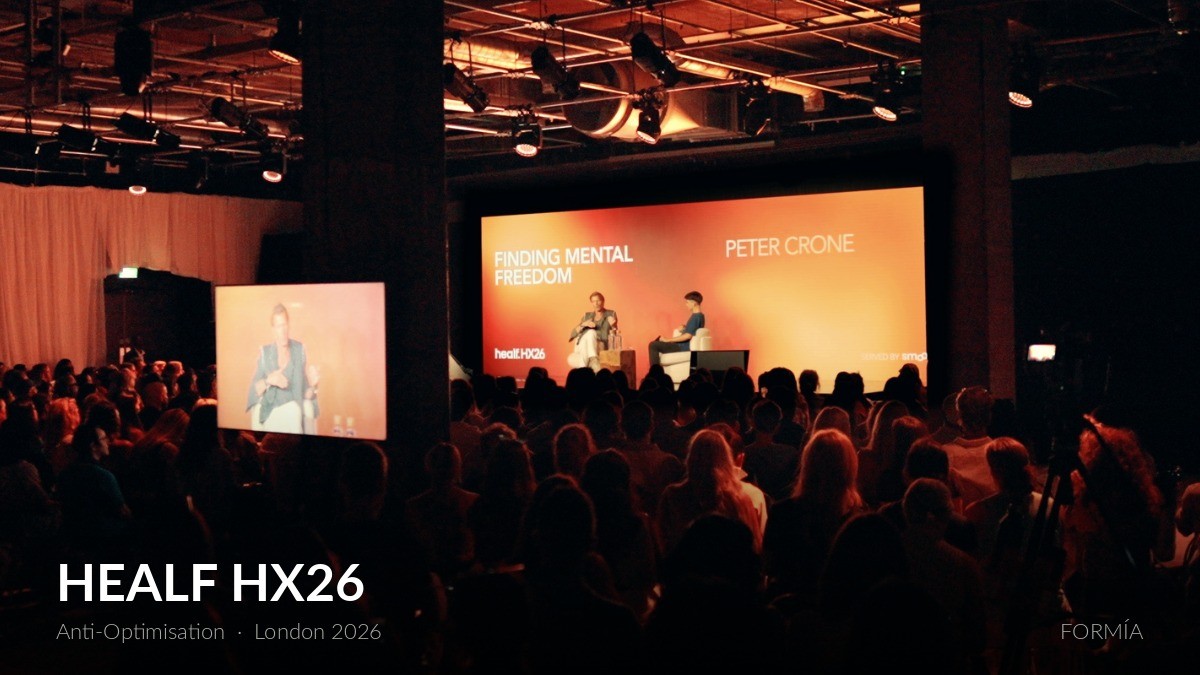
The biggest wellness conference in Europe this year had one theme. Not longevity. Not biohacking. Anti-Optimisation.
The brands that understand why will be very hard to ignore.
Healf HX26 brought several thousand people to one building in London. Andrew Huberman, Gary Brecka, Barbara Sturm, Dave Asprey. Sessions on sleep, longevity, skin science, and supplementation. But the current running through it all was the same: the decade of more is over.
The market is asking a different question now.
When more became the problem
For most of the last decade, the wellness industry has been built on a single premise: more is better.
Add a morning routine. Add a supplement stack. Add cold exposure. Add infrared. Add intermittent fasting. Add continuous glucose monitoring. Add peptides. Add red light.
The industry responded to every new behaviour with a new product. Clinics added services. Brands added claims. Everyone added channels. The consumer followed, built spreadsheets to track their protocols, and waited to feel better.
At some point, quietly, it stopped working. Not because the science was wrong. Because the human at the centre of it could not keep up with the system designed to help them.
What the data shows in 2026
This is not one conference reading the room. The Global Wellness Institute placed optimisation backlash as a top trend for 2026. The signal is consistent across markets.
Vichy opened a dedicated Longevity Clinic this year. Shiseido and Lancôme announced longevity research programmes. Unilever is reportedly in acquisition talks for Thorne HealthTech at a valuation of several billion dollars.
None of these moves are about adding more. They are about establishing authority in one clear area and communicating it without noise.
The largest brands in the industry are choosing. Not expanding.

What this means for wellness brands in Switzerland and Europe
The clients of premium wellness clinics, studios, and medical aesthetics practices in Switzerland are not new to this space.
They have had the consultations. Tried the protocols. Read the research. They are not looking for more options. They are looking for a brand they can trust to have already done the thinking for them.
Most wellness brands we encounter are still communicating through addition. More treatments. More proof points. More premium signals stacked on top of each other until none of them read as premium anymore.
The client is no longer asking whether something is good. They are asking whether it is right for them.
That is a different question. And most brand communications are not built to answer it.
The practices and clinics that are getting this right are doing something counterintuitive. They are choosing fewer messages. One clear positioning. One specific kind of client they serve exceptionally well. And they communicate that with the kind of specificity that only comes from genuine expertise.

What Anti-Optimisation actually requires
The wellness market is not getting simpler. It is getting more demanding.
Anti-Optimisation is not a trend to follow. It is a signal that the clients who matter most are now sophisticated enough to see through noise.
For wellness brands in Switzerland, where the client is typically high value, discreet, and already well informed, this has been true for longer than the global conversation suggests.
What it requires is not a communications refresh. It requires a brand that knows precisely what it stands for before it decides what to say.
Most brands are not there yet.
The ones that are are very difficult to ignore.
FORMÍA is a marketing studio for premium health, beauty and wellness brands in Switzerland.