

BRAND STRATEGY · 25 OCTOBER 2026 · 17 MIN READ
Last updated: 25 October 2026
In 2026, the rules for marketing a clinic, a practice or a wellness brand in Switzerland became stricter, and authorities now enforce them more actively. Inspectors review websites and Instagram accounts as part of their checks on laser and IPL treatments. Swissmedic has updated its rules on how clinics may talk about botulinum toxin. The EU has new rules on green claims and AI images that apply to Swiss brands selling across the border. At the same time, more patients start their research with an AI assistant instead of a search results page.
This guide brings these changes together in one place. It is written for owners and managers of aesthetic and dermatology clinics, cosmetology studios, and wellness and skincare brands in Switzerland.
In short
- Inspectors review websites and Instagram accounts as part of a national enforcement campaign for laser and IPL treatments, which runs until the end of 2026.
- Since 1 March 2026, clinics may not name botulinum toxin brands, show before-and-after images on websites or offer discounts on these treatments.
- Two EU rules now reach Swiss brands that advertise across the border: the ban on generic green claims and the disclosure of realistic AI images.
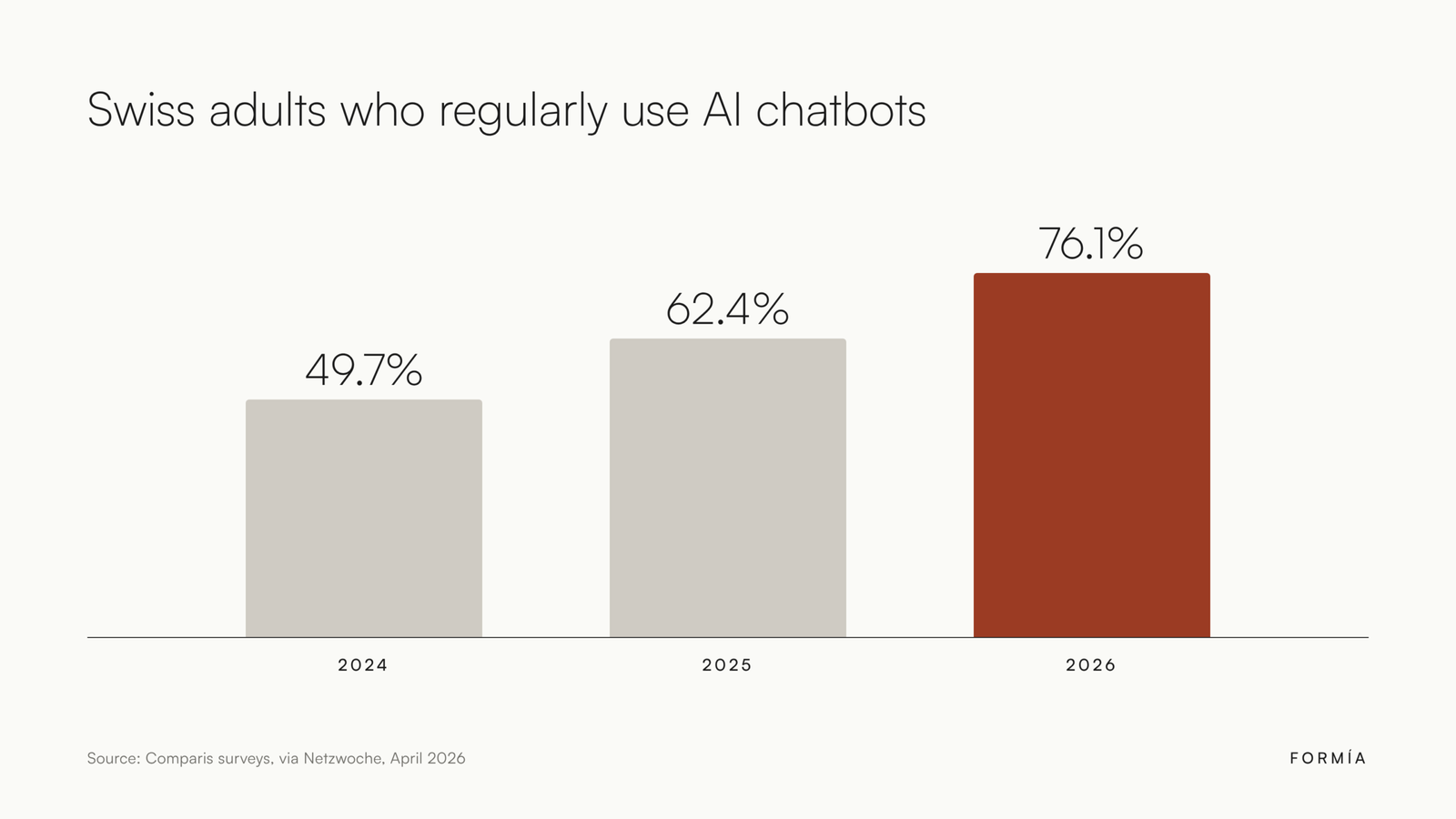
- 76% of Swiss adults use AI chatbots regularly. A clinic or brand needs to be the source those assistants quote.
- A tracking pixel on a treatment page can reveal health data, which Swiss law treats as particularly sensitive.
What changes in 2026 at a glance
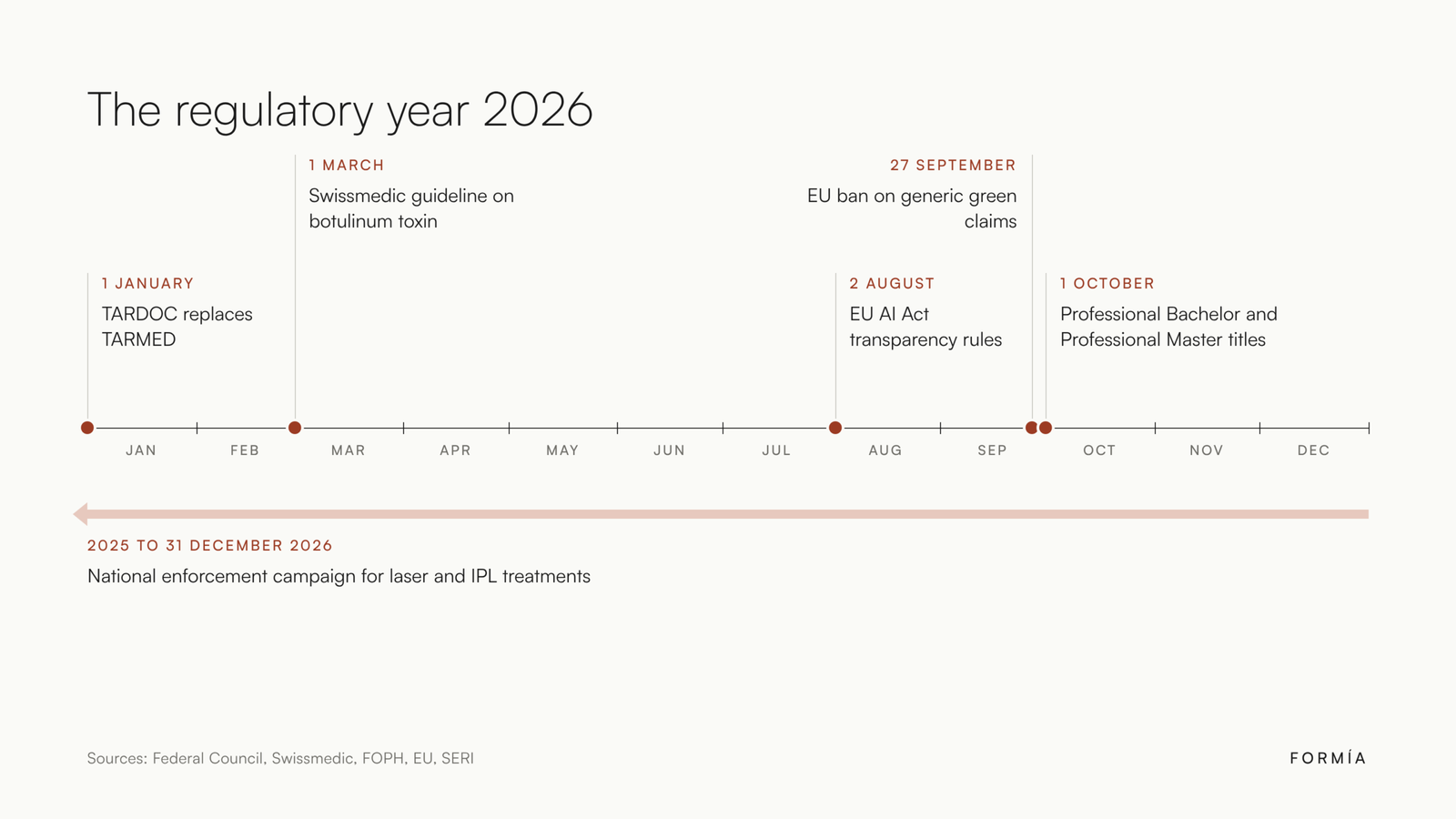
Six changes with a fixed date shape 2026. The timeline shows their order, and the table below gives the details and the official source for each one.
| Date | What changes | Who it affects |
|---|---|---|
| Since 1 Jan 2026 | TARDOC and outpatient flat rates replace the TARMED tariff (Federal Council) | Medical practices, including dermatology |
| Since 1 Mar 2026 | Swissmedic guideline on botulinum toxin, version 2.2: no brand names, no before-and-after images on websites, no discounts (Swissmedic) | Aesthetic and dermatology clinics |
| 2025 to end of 2026 | National enforcement campaign for laser, IPL and similar treatments. Inspectors also review websites and social media (FOPH) | Cosmetology studios and clinics with devices |
| Since 2 Aug 2026 | EU AI Act transparency rules, including disclosure of realistic AI-generated images (ICTRecht) | Brands advertising to EU audiences |
| Since 27 Sep 2026 | EU ban on generic environmental claims and uncertified sustainability labels (Directive (EU) 2024/825) | Skincare and wellness brands selling in the EU |
| Since 1 Oct 2026 | Holders of federal higher vocational qualifications may use the titles Professional Bachelor or Professional Master (SERI) | Cosmeticians, their employers and their communication |
Two earlier changes shape the same year. Google launched AI Mode in Switzerland on 8 October 2025, in German, French and Italian (Blick). The Federal Data Protection Commissioner updated its guide on cookies and tracking on 6 October 2025 (FDPIC guide, v1.1).
The market: more spending, more research, fewer clicks
Health spending in Switzerland keeps rising, and most adults now use AI assistants in everyday life. These figures describe the environment every clinic and brand works in.
The table brings together the most recent official and industry figures. The first three rows describe spending, the next two the aesthetic market worldwide, and the last three how people search for and choose a provider.
| Indicator | Figure | Source |
|---|---|---|
| Swiss healthcare costs, 2024 | CHF 97 billion, up 4.1% on 2023 | Federal Statistical Office, via Keystone-SDA |
| Healthcare costs per person, 2024 | CHF 10,792 | Federal Statistical Office, via ZWP |
| Wellness spending per person, 2024 | Above USD 5,000 in Switzerland, against USD 831 globally | Global Wellness Institute |
| Aesthetic procedures worldwide, 2024 | Nearly 38 million, of which about 20.5 million non-surgical | ISAPS Global Survey |
| Most common non-surgical treatments, 2024 | Botulinum toxin 7.8 million, hyaluronic acid fillers 6.3 million | ISAPS Global Survey |
| Swiss adults who regularly use AI chatbots, 2026 | 76.1%, up from 49.7% in 2024 | Comparis survey, via Netzwoche |
| Swiss residents who expect a personal benefit from chatbots as health assistants | 56%, up from 47% in 2024 | Swiss eHealth Barometer 2026 |
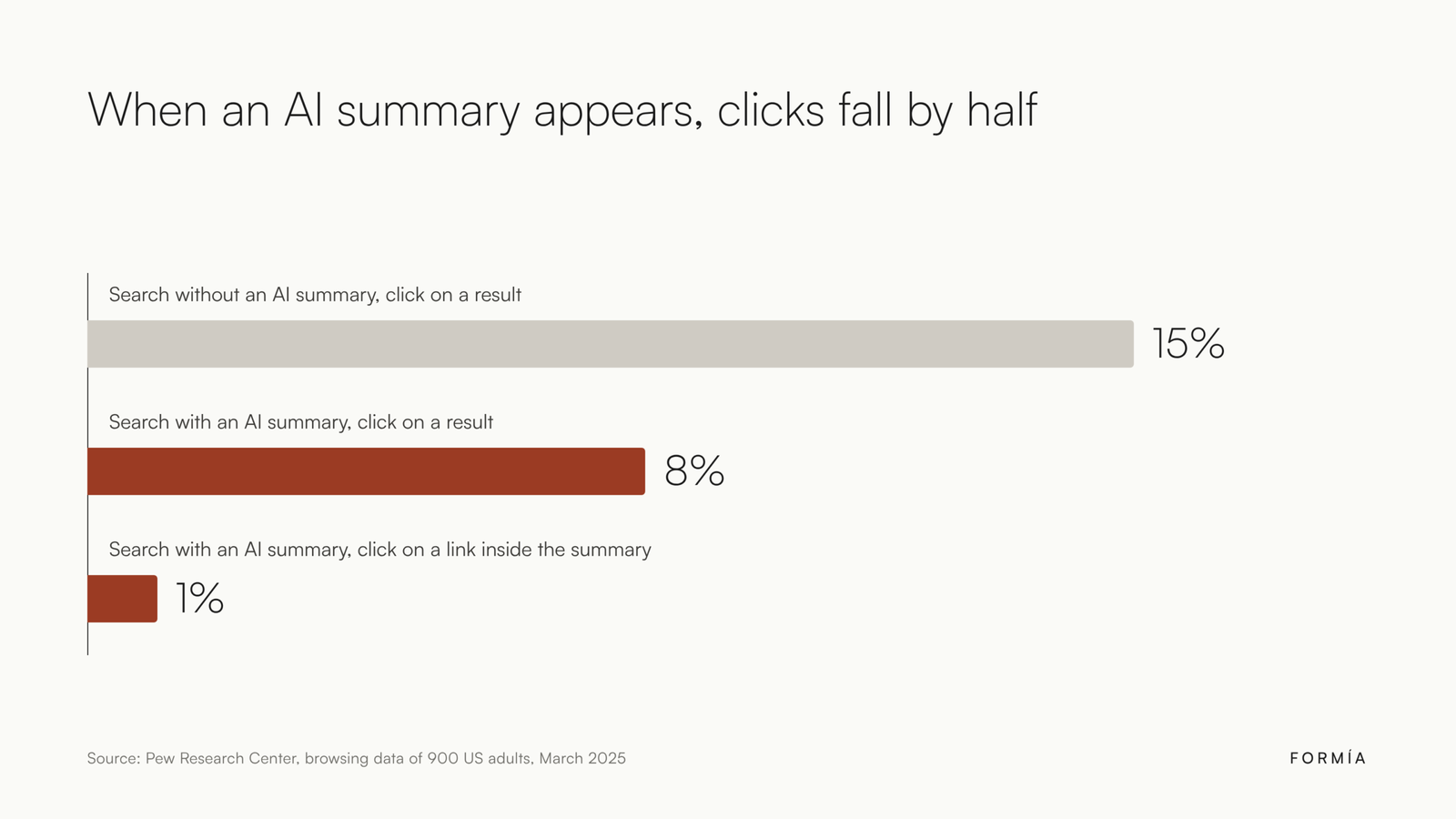
| Google searches in which users clicked a result when an AI summary appeared | 8%, against 15% without a summary | Pew Research Center |
Demand is strong and well funded. Swiss patients and customers spend more, and they expect a matching level of quality in every contact with a brand.
The decision starts earlier. More and more people ask an AI assistant which clinic to choose, what a treatment involves or whether a product is safe. The answer they receive is assembled from what the assistant finds about a business online.
A good website alone no longer guarantees a visit. When an AI summary answers the question, fewer people click through. A brand now needs to be the source that AI assistants quote, with clear, accurate and consistent information across its website, its Google Business Profile and the sites that mention it.
When an AI summary answers the question, the brand that wins is the one the summary quotes.
Rules for clinics, practices and studios
The most important change for clinics is that their marketing is now part of the evidence. What a website or an Instagram account offers tells inspectors which treatments are performed and by whom.
Laser, IPL and other devices: inspectors read your Instagram
Since 1 June 2024, anyone who performs cosmetic treatments with lasers, IPL, ultrasound or radiofrequency needs a certificate of competence (Sachkundenachweis) under the V-NISSG ordinance (FOPH). Some treatments are reserved for physicians, and some are prohibited.
The table sorts the most common treatments into three groups: those that need a certificate, those reserved for physicians and those that are prohibited.
| Category | Examples |
|---|---|
| Certificate of competence required | Hair removal with laser or IPL, tattoo and permanent make-up removal with short-pulsed lasers, acne, wrinkle, scar and pigment treatments, couperose, non-invasive cellulite and fat treatments |
| Reserved for physicians | Treatments on or near the eyelids, HIFU, ablative lasers such as CO2 and Er:YAG, long-pulsed Nd:YAG, photodynamic therapy, invasive laser lipolysis |
| Prohibited | Tattoo removal with IPL, removal of moles (melanocytic naevi) with any laser |
Source: FOPH guidance on treatments with non-ionising radiation and sound. Check the full list before you publish a treatment page.
A national enforcement campaign started in 2025 and runs until the end of 2026. According to the FOPH enforcement guide, spot checks can include internet research and searches on Instagram and Facebook for treatments that require a certificate, are reserved for physicians or are prohibited. Advertising on a website, on site or on social media counts as a criterion when authorities judge whether a treatment is performed unlawfully (FOPH enforcement guide, sections 3.5, 3.7 and 5.5).
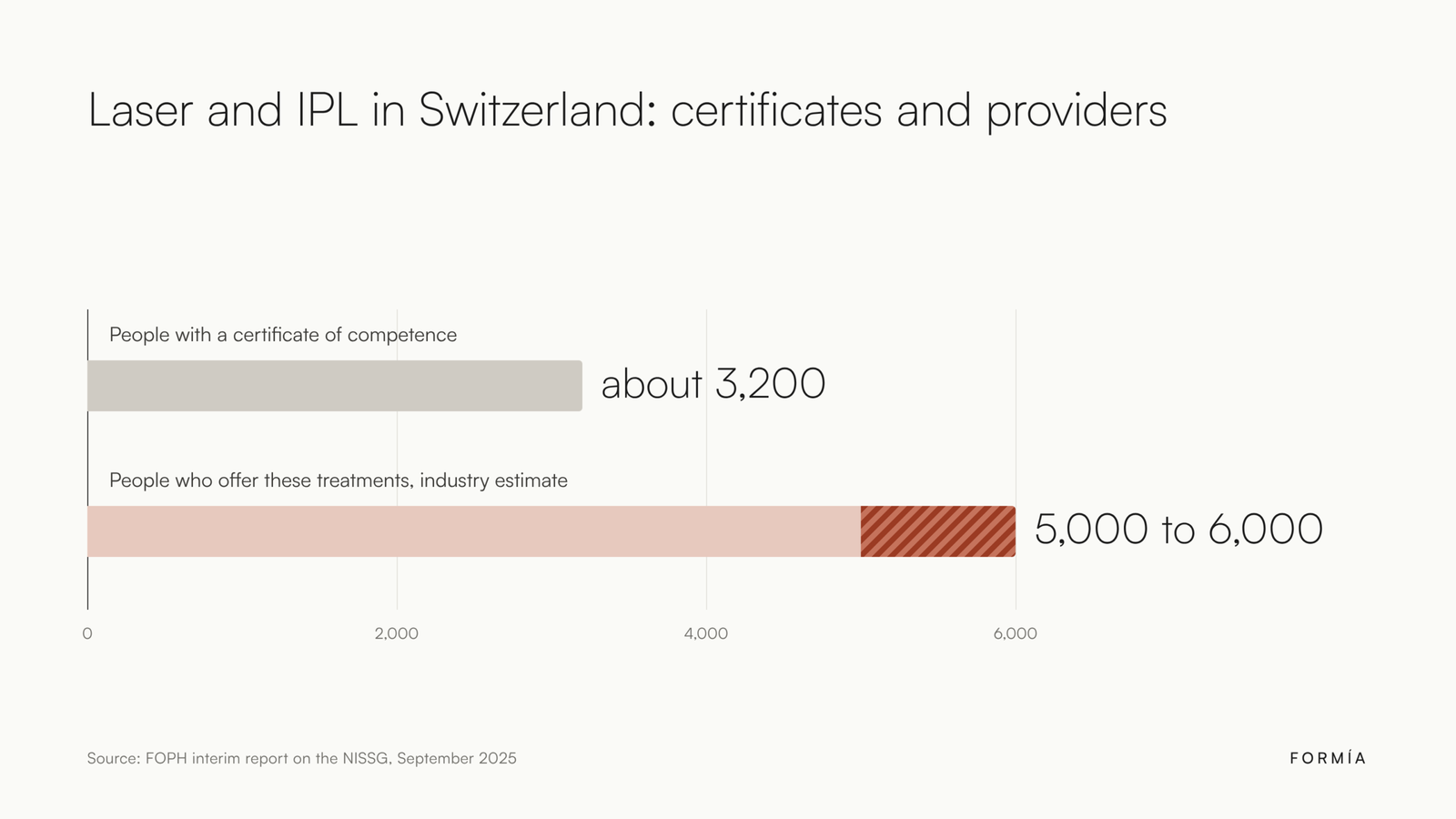
The stakes are real. Performing a treatment without the required certificate can lead to a fine of up to CHF 40,000. A prohibited treatment can lead to imprisonment of up to one year or a monetary penalty. The FOPH’s interim report counts about 3,200 certificate holders, while industry associations estimate that 5,000 to 6,000 people offer these treatments (FOPH interim report, September 2025).
What this means for marketing: every treatment named on a website, in an ad or in a post must match the qualifications of the person who performs it. A studio that advertises a physician-only treatment is advertising a violation.
A studio that advertises a physician-only treatment is advertising a violation.
Doctors and health professionals: objective information only
Physicians may only advertise in a way that is objective, meets a public need and is neither misleading nor intrusive (Art. 40 let. d of the Medical Professions Act, MedBG). The cantons enforce this rule, and their interpretation is strict.
The directive of the Canton of Neuchâtel from November 2025 is a clear example (Neuchâtel directive). It allows information on qualifications, services, languages, opening hours and prices for services outside basic insurance. It prohibits:
- patient photos and patient testimonials on a website;
- asking patients for online reviews;
- free consultations, discounts and other incentives;
- self-praise and loud, promotional language;
- mass mailings, flyers and unsolicited emails.
The directive also makes the professional responsible for advertising that others publish on their behalf, including an agency. Rules differ between cantons, so a clinic in Basel, Zurich or Geneva should check its own canton’s practice.
Botulinum toxin and other prescription medicines
Prescription-only medicines may not be advertised to the public (Art. 32 para. 2 let. a of the Therapeutic Products Act, HMG). Botulinum toxin products are prescription-only. Swissmedic’s guideline, valid since 1 March 2026, spells out what this means for clinics (Swissmedic guideline MU105_00_002, version 2.2):
| Allowed | Not allowed |
|---|---|
| General information about health, skin and treatment options | Brand names such as “Botox” on clinic websites |
| Describing a treatment without naming a product | Before-and-after images on websites, in any case |
| Discounts on botulinum toxin treatments | |
| Promoting uses the product is not approved for |
Swissmedic judges the overall impression of a page. A prominent placement or an advertising tone can turn information into advertising, even without a product name.
Fillers and other medical devices
Most dermal fillers are medical devices. Devices intended only for use by healthcare professionals may not be advertised to the public, and all claims must match the official product information (Art. 69 of the Medical Devices Ordinance, MepV, unofficial English text). In practice, a clinic can describe a treatment and its purpose. It should not promote a filler brand to patients.
New titles: Professional Bachelor and Professional Master
Since 1 October 2026, holders of a federal professional examination or a higher technical school diploma may add “Professional Bachelor” to their title. Holders of an advanced federal professional examination may add “Professional Master”. The titles apply regardless of when the qualification was earned (SERI). For cosmetology studios, this is an opportunity to show qualified staff more clearly on websites, in job ads and on team pages.
TARDOC for medical practices
Since 1 January 2026, the TARDOC tariff and outpatient flat rates have replaced TARMED, which had been in place for about 20 years (Federal Council). Dermatology practices that offer both insured and self-paid treatments should keep their price communication for self-paid services clear and separate.
Rules for skincare, supplement and wellness brands
For brands, the key question is which claims they can prove. Swiss law already limits health claims, and two EU rules now reach Swiss brands that sell or advertise across the border.
Cosmetics: no healing claims
Cosmetics may not claim to cure, relieve or prevent a disease (Art. 47 of the Food and Utility Articles Ordinance, LGV). Their claims may not be misleading and may not suggest properties a product does not have. They must also meet the six criteria in Annex 6 of the Cosmetics Ordinance, VKos (Canton of Aargau fact sheet, March 2026).
In practice, “reduces the appearance of fine lines” describes a cosmetic effect. “Treats acne” or “heals eczema” describes a medical effect, which a cosmetic may not claim.
Supplements: only approved health claims
A health claim on a food or supplement may only be used if it is listed in Annex 14 of the Ordinance on Food Information (LIV) and its conditions are met. Any other health claim needs prior approval from the Federal Food Safety and Veterinary Office (FSVO), which grants it only when the effect is scientifically proven (FSVO). This applies to packaging, websites, social media and influencer content alike.
EU green claims: from 27 September 2026
The EU Directive on Empowering Consumers for the Green Transition (EmpCo) applies from 27 September 2026 (Directive (EU) 2024/825; DWF). It treats the following as misleading in every case:
- generic environmental claims, such as “eco-friendly” or “green”, without proof of recognised excellent environmental performance;
- sustainability labels that are not based on a certification scheme or set up by public authorities;
- environmental claims about a whole product when they concern only one part of it;
- claims of a neutral or reduced climate impact that rely on offsetting.
A Swiss skincare or wellness brand that sells to consumers in Germany, Austria, France or Italy should review its packaging, product pages and ads for these claims.
AI images in advertising: from 2 August 2026
The transparency rules of the EU AI Act (Article 50) apply from 2 August 2026. Businesses that publish realistic AI-generated or AI-manipulated images, video or audio must disclose this. The rule covers advertising, synthetic models and AI-edited product images that could appear authentic. Intent to deceive is not required (ICTRecht, August 2026).
For beauty brands, this matters most for skin results. An AI-retouched result image that looks real now raises two questions at once: is it misleading under advertising law, and does it need an AI disclosure under the AI Act?
Claims check: examples
The table shows how typical marketing claims are assessed under the rules above. It is a guide for a first review, and each product still needs its own check.
| Claim | Where it appears | Assessment |
|---|---|---|
| “Reduces the appearance of fine lines” | Cosmetic | Describes a cosmetic effect. Allowed if it is true and substantiated |
| “Treats acne” | Cosmetic | Describes a medical effect. Not allowed for cosmetics (LGV Art. 47) |
| A health claim worded differently from Annex 14 LIV | Supplement | Needs FSVO approval before use |
| “Eco-friendly formula” | Product sold in the EU | Generic environmental claim. Banned under EmpCo without proof of recognised excellent environmental performance |
| “Climate neutral” based on offsetting | Product sold in the EU | Banned under EmpCo |
| A realistic AI-generated result image | Advertising in the EU | Must be disclosed as AI-generated (AI Act Art. 50) |
Data and tracking: health data is sensitive data
A booking form, a skin quiz or a pixel on a treatment page can collect health data. Under Swiss law, that changes what a clinic or brand may do with it.
The revised Federal Act on Data Protection (FADP) has applied since 1 September 2023 and treats health data as particularly sensitive (SME Portal of the Swiss Confederation). Intentional breaches of key duties can lead to fines of up to CHF 250,000 for the responsible individuals (FADP, SR 235.1).
The Federal Data Protection and Information Commissioner (FDPIC) set out its position on cookies and tracking in a guide updated on 6 October 2025 (FDPIC guide, v1.1):
| Situation | What the FDPIC expects |
|---|---|
| Ordinary advertising cookies and profiling | A clear, prominent option to refuse (opt-out) |
| Cookies that process sensitive data or create high-risk profiles | Explicit consent before any processing (opt-in) |
| Cross-site tracking by third parties | Can reach high-risk profiling. If unsure, assume high risk |
| Third-party tools embedded on your site | The website operator remains responsible |
Google’s EU user consent policy has also applied to users in Switzerland since 31 July 2024 (Usercentrics).
What this means for marketing: a tracking pixel on a page about a specific treatment can reveal a person’s health interest. Clinics and health brands should use a consent banner with a real choice, keep health details out of URLs and tracking events, and check which data their booking and form tools send to third parties.
Platforms: Google, AI search and Meta
The channels that bring patients and customers are changing their own rules at the same time as the law.
Google and AI search
Google launched AI Mode in Switzerland on 8 October 2025 in German, French and Italian (Blick). In a study of 900 US adults, Pew Research Center found that users clicked a traditional result in 8% of searches with an AI summary, against 15% without one. Only 1% clicked a link inside the summary (Pew Research Center, July 2025). Google disputes that traffic has dropped sharply.
For a clinic or brand, visibility in 2026 depends on four things:
- A complete Google Business Profile. It is often the first and only page a patient sees before calling.
- Pages that answer one question clearly. AI assistants quote content that gives a direct, specific and accurate answer.
- Consistent facts everywhere. Name, address, services, qualifications and opening hours should match on the website, the Google profile, directories and social media.
- Mentions on trusted sites. Associations, partners, press and professional directories confirm what a business says about itself.
Google’s healthcare advertising policy also restricts ads related to prescription drugs and requires advertisers to follow the local law of every country they target (Google Ads policy). In Switzerland, that local law includes the advertising rules for medicines and medical devices described above.
Meta: limits on health and wellness data
Since 2025, Meta has limited the data that health and wellness advertisers can share through the Meta Pixel and its other business tools. Depending on how an account is classified, the restrictions range from blocking custom parameters and detailed URLs to blocking optimisation for lower-funnel events such as purchases. In the most severe tier, no events can be used for optimisation (Search Engine Land). Advertisers can see their status in Events Manager.
The restrictions come in three levels:
| Level | What Meta restricts | What still works |
|---|---|---|
| Core setup | Custom parameters and URL details, some reporting, automatic advanced matching | Standard events, upper-funnel and lower-funnel optimisation |
| Restricted standard events | Optimisation for mid- and lower-funnel events such as add to cart and purchase | Upper-funnel events, custom events, lead forms in the app |
| Full restrictions | All events for campaign optimisation | Awareness and reach campaigns |
What this means for marketing: clinics and wellness brands on Meta should check their data source category, plan campaigns that work with upper-funnel signals, and measure bookings through their own systems as well as through Meta.
What to review before the end of 2026
Most of these points can be checked in a few days. They protect a business from fines and make it easier for patients, customers and AI assistants to trust it.
| What to review | Applies to | Why |
|---|---|---|
| Every treatment on the website, Google profile and Instagram matches the certificate or medical qualification of the person who performs it | Cosmetology studios, aesthetic clinics | NISSG enforcement campaign until end of 2026 |
| No product brand names, before-and-after images or discounts for botulinum toxin | Aesthetic and dermatology clinics | Swissmedic guideline since 1 March 2026 |
| No patient testimonials, review requests, free consultations or discounts in physicians’ advertising | Medical practices | MedBG Art. 40 let. d and cantonal practice |
| Filler and device brands are not promoted to patients | Aesthetic clinics | MepV Art. 69 |
| Qualified staff are shown with their correct titles, including Professional Bachelor or Master where it applies | Cosmetology studios | New titles since 1 October 2026 |
| No healing claims for cosmetics, and only approved health claims for supplements | Skincare and supplement brands | LGV Art. 47, VKos Art. 10, LIV Annex 14 |
| No generic green claims or uncertified sustainability labels in EU markets | Brands selling in the EU | EmpCo since 27 September 2026 |
| Realistic AI images in EU advertising are disclosed | Brands advertising in the EU | AI Act Art. 50 since 2 August 2026 |
| Consent banner with a real choice, and no health details in URLs or tracking events | All | FADP and FDPIC guide |
| Meta data source category checked, and bookings measured in your own system | All advertisers on Meta | Meta health and wellness restrictions |
| Google Business Profile complete, and the same facts on every platform | All | AI Mode and AI assistants |
These rules do not make good marketing impossible. They reward the same things patients value: accurate information, qualified people, honest results and respect for their data.
Frequently asked questions
No. According to Swissmedic’s guideline, valid since 1 March 2026, brand names such as “Botox” may not appear on clinic websites. A clinic may give general information about wrinkle treatments without naming a product.
For botulinum toxin treatments, Swissmedic does not allow before-and-after images on websites in any case. For physicians, some cantons go further. The Canton of Neuchâtel, for example, prohibits patient photos on websites. Check the rules of your canton before publishing any patient result.
Yes. The FOPH enforcement guide for the V-NISSG names internet research and searches on Instagram and Facebook as part of spot checks and treats advertising as a criterion when judging whether a treatment is performed unlawfully.
It applies to commercial practices aimed at consumers in the EU. A Swiss brand that sells or advertises to consumers in an EU country should follow it for those markets.
Under the Neuchâtel directive, the health professional remains personally responsible for advertising published on their behalf. A good agency should know these rules and check every piece of content against them.
A cosmetician with a federal professional examination may add “Professional Bachelor” to the existing title from 1 October 2026. A holder of the advanced federal examination may add “Professional Master”. It is an addition to the title. It is not an academic degree.
Yes, if the person who performs it holds the certificate of competence required under the V-NISSG. Treatments reserved for physicians, such as ablative lasers or HIFU, should not appear in a studio’s offer.
It depends on what they offer. A wellness centre that uses lasers, IPL, ultrasound or radiofrequency for cosmetic purposes falls under the V-NISSG. A centre that sells cosmetics or supplements must follow the rules on cosmetic and health claims.
Swiss law does not require a banner in every case. The FDPIC expects explicit consent for cookies that process sensitive data or create high-risk profiles. Health-related websites should therefore offer a real choice before tracking starts.
Assistants with web search build their answers from what they find online: the business’s own website, its Google Business Profile, directories, press and other sites that mention it. Clear, consistent and accurate information across these sources makes a correct answer more likely.
Is your marketing ready for 2026?
FORMÍA reviews websites, ads and social media of health, beauty and wellness businesses against these rules, and builds marketing that works within them.
Sources
Swiss authorities and law
- Federal Office of Public Health: treatments with non-ionising radiation and sound
- FOPH: overview of treatments under the V-NISSG
- FOPH: enforcement guide V-NISSG, cosmetic use of products
- FOPH: interim report on the NISSG, 2019 to 2024 (September 2025)
- Swissmedic: botulinum toxin, information versus advertising, version 2.2
- Therapeutic Products Act, Art. 32 (unofficial English text)
- Medical Devices Ordinance, Art. 69 (unofficial English text)
- Canton of Neuchâtel: advertising directive for health professionals, November 2025
- Canton of Aargau: fact sheet on selling cosmetics in Switzerland, March 2026
- Federal Food Safety and Veterinary Office: approval of health claims
- State Secretariat for Education, Research and Innovation: Professional Bachelor and Professional Master, June 2026
- Federal Council: new outpatient tariffs from 2026
- Federal Act on Data Protection, SR 235.1
- SME Portal: data protection, what you need to know
- FDPIC: guide on cookies and similar technologies, version 1.1, October 2025
European Union
- Directive (EU) 2024/825 on empowering consumers for the green transition
- DWF: empowering consumers for the green transition, February 2026
- ICTRecht: AI Act transparency obligations now in effect, August 2026
Market and platforms
- Keystone-SDA: healthcare costs rose by 4.1% to CHF 97 billion in 2024
- ZWP: healthcare costs per person by canton, 2024
- Global Wellness Institute: global wellness economy country rankings
- ISAPS: Global Survey 2024, press release
- Netzwoche: Comparis survey on AI chatbot use, April 2026
- Swiss eHealth Barometer 2026, population survey
- Pew Research Center: Google users are less likely to click on links when an AI summary appears, July 2025
- Blick: Google AI Mode comes to Switzerland, October 2025
- Google Ads: healthcare and medicines policy
- Usercentrics: Google consent requirements in Switzerland
- Search Engine Land: Meta Ads restrictions for health and wellness campaigns
This article provides general information on the situation as of 25 October 2026. It is not legal advice. Rules can differ between cantons, so check specific cases with the competent authority or a legal specialist.
About the author

Ieva Lekaviciene is the founder of FORMÍA, a marketing studio in Basel for health, beauty and wellness brands.
FORMÍA takes care of the whole brand, from strategy and advertising to websites, content and events.