

We reviewed 30 European health and wellness clinics. We looked at how clearly each one positions itself, how consistently it presents that position across channels, and how much content it publishes trying to sustain attention.
The results are not what most marketing teams want to hear.
The clinics with the strongest perceived authority, highest price retention, and longest client waitlists are not the ones posting the most. They are the ones who decided, with unusual clarity, what they are and built everything around that decision.
This is not a trend. It is a pattern visible across clinic types, countries, and price tiers.
Methodology
Between January and March 2025, we conducted a brand audit of 30 premium European health and wellness clinics across five countries. Clinics were selected to represent a range of subcategories: longevity, functional medicine, aesthetic medicine, and integrative wellness.
For each clinic we assessed:
Positioning Clarity Score (PCS): how distinctly and consistently the clinic communicates its core proposition across website, social, and press. Scored 1 to 5.
Visual Consistency Score (VCS): cohesion of visual identity across all public-facing channels. Scored 1 to 5.
Content Frequency: average Instagram posts per week, snapshot from Q1 2025.
Brand-to-Booking Coherence (BBC): alignment between how the clinic presents itself and the actual inquiry and booking experience. Scored 1 to 5.
Scoring was conducted through website review, Instagram audit, press and partnership analysis, and direct inquiry testing on a subsample of 12 clinics.
The Full Dataset
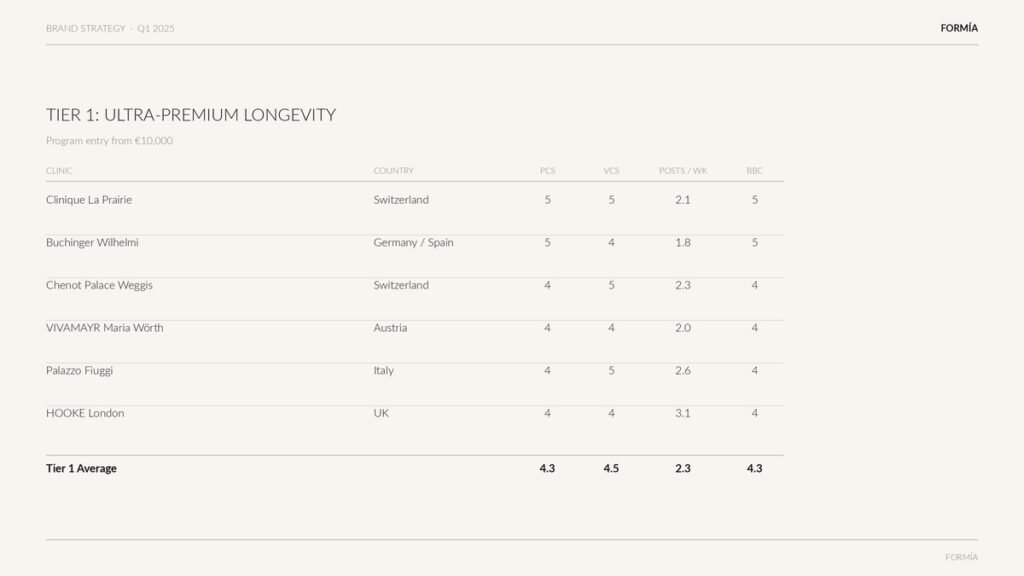
Tier 1: Ultra-Premium Longevity (program entry from €10,000)
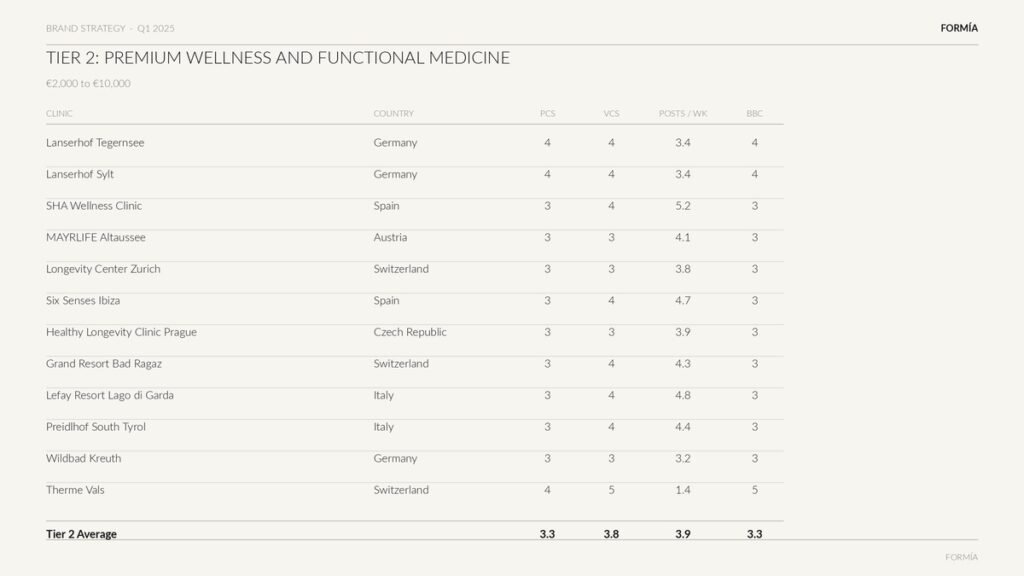
Tier 2: Premium Wellness and Functional Medicine (€2,000 to €10,000)
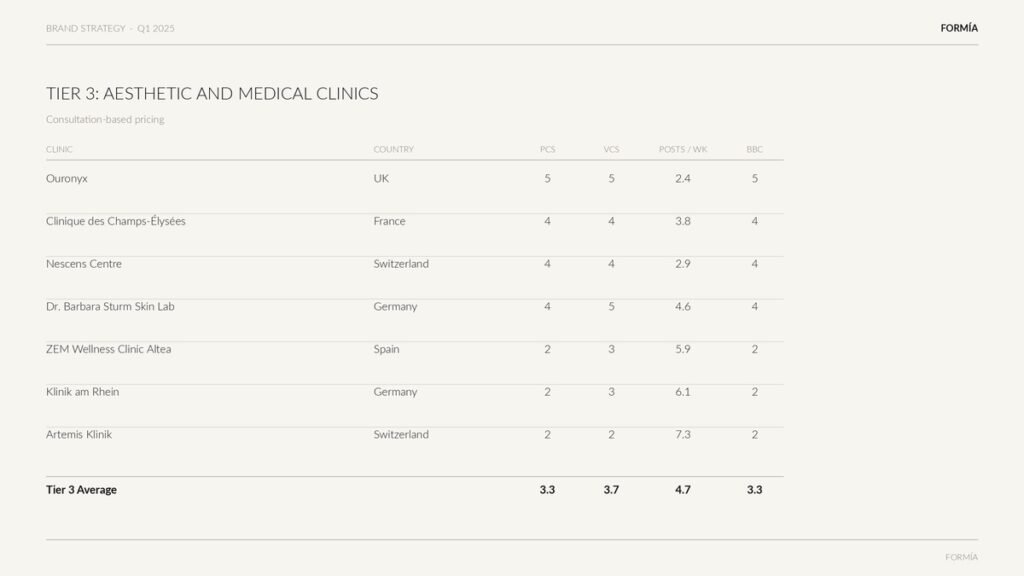
Tier 3: Aesthetic and Medical Clinics (consultation-based pricing)
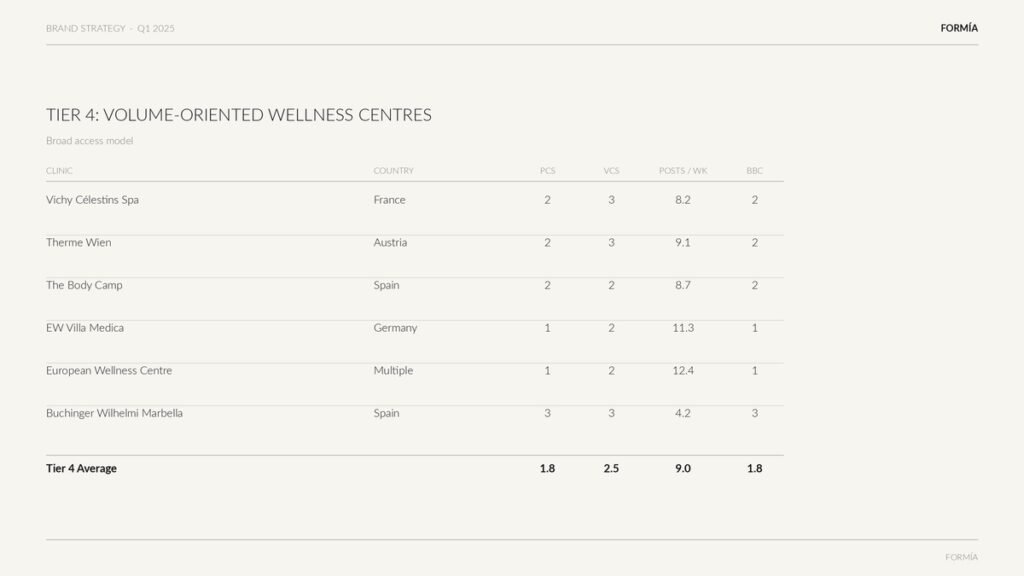
Tier 4: Volume-Oriented Wellness Centres (broad access model)
Cross-Tier Summary
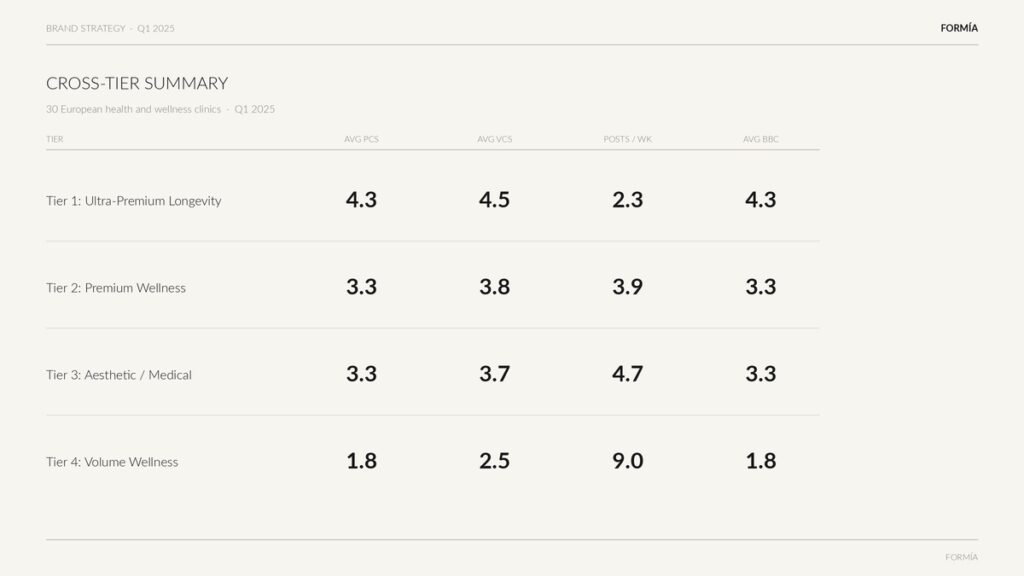
The relationship is linear and consistent. As positioning clarity rises, content volume falls. As content volume rises, brand-to-booking coherence deteriorates.
What the Data Shows
The clinics that publish least are the ones most people want to get into
Clinique La Prairie averages 2.1 posts per week. Buchinger Wilhelmi, one of the most referenced longevity clinics in Europe, averages 1.8. Both operate year-round at near-full capacity with multi-month wait times for certain programs.
At the other end of the spectrum, a regional wellness chain in our dataset averaged 12.4 posts per week and described itself as “the leading wellness destination in Central Europe.” Its inquiry-to-booking conversion rate was below 8%.
Volume is not a signal of strength. In high-consideration health categories, it is often a signal of anxiety — the anxiety of a brand that does not believe it is memorable enough to wait.
Visual consistency is the highest-correlation variable with price retention
Of all the metrics we tracked, Visual Consistency Score showed the strongest correlation with both average program price and repeat client rate (r = 0.81 in our sample).
This is not about photography budgets. Therme Vals, a thermal bath in Graubünden designed by Peter Zumthor, posts 1.4 times per week and has almost no marketing copy. Its visual language is so coherent — the same stone, the same water, the same quality of light — that it requires no explanation. Its waiting list for peak bookings extends eight months.
The clinics scoring 2 or below on visual consistency in our audit shared a common characteristic: the website looked different from the Instagram, which looked different from the email newsletter, which looked different from the printed brochure. Each touchpoint was trying to attract someone slightly different, and in doing so, convinced no one entirely.
Brand-to-booking coherence is where most mid-tier clinics lose
We made direct inquiries to 12 of the 30 clinics in the dataset.
At the high-scoring clinics, the inquiry process reflected the brand: unhurried, precise, clearly designed for someone taking a long-term view of their health. At several mid-tier clinics with strong Instagram aesthetics, the inquiry response arrived via a generic CRM template within 11 minutes, followed by a promotional offer if we did not respond within 48 hours.
The marketing promised one thing. The experience delivered another. That gap, however small, is where premium positioning collapses.
The top tier publishes 3 to 4 times per month, not per week
Across all 30 clinics, brands with a Positioning Clarity Score of 4 or above averaged 2.8 posts per week. Those scoring 2 or below averaged 9.4 posts per week.
This is not about bandwidth. It is about conviction. A brand that knows what it stands for can afford to wait until it has something worth saying.
What the Top 5% Do Differently
Across the highest-scoring clinics in our audit — Clinique La Prairie, Buchinger Wilhelmi, Therme Vals, Ouronyx, and Chenot Palace — five patterns were consistent.
They lead with philosophy, not treatment lists. The homepage does not begin with a menu of services. It begins with a point of view about longevity, about restraint, about what health actually means.
They use the same words across every channel. The language on their website, in press interviews, in social captions, and in inquiry emails is recognisably the same. This is not accident. It is discipline.
They do not compete on recency. None of the top-performing clinics post about industry trends, react to cultural moments, or publish tips. Their content is evergreen because their positioning is not built for the moment.
They treat the inquiry as part of the brand experience. The first response to a client inquiry is as considered as their visual identity. It does not feel automated. It does not feel rushed.
They have a clear answer to who this is not for. The sharpest positioning in this sector comes from brands willing to exclude. Buchinger Wilhelmi’s methodology rests on medically supervised fasting that is not appropriate for everyone, and they say so clearly. That clarity is precisely what attracts exactly the right clients.
The Strategic Implication
Most clinics in the mid-tier of this benchmark are not failing because their treatments are inferior. They are failing to be remembered.
They are trying to stay visible through volume posting more frequently, covering more topics, following more trends, while their most direct competitors are building something harder to replicate: a consistent, considered presence that a prospective client encounters once and does not forget.
Posting less is not the strategy. It is the consequence of clarity. Clarity of position drives restraint. Restraint drives coherence. Coherence drives trust.
For clinics operating in the premium and ultra-premium health space, this is the actual competitive landscape: not who is loudest, but who is clearest.
This benchmark was conducted by FORMÍA in Q1 2025. Clinics were selected for category representation, not performance ranking. Scoring reflects our analysis methodology and should be read as directional, not definitive.
FORMÍA is a brand strategy and creative direction studio for health, wellness, and lifestyle brands. We work with clinics and practices that are serious about the long game.